
Fuel Filter Facts (Ignore your filters at your peril…)
“Safety Articles, presented at CCA Stations and Posts”
By Dick Stevenson, New York Station
Boats going to sea often fail to prepare for events that are actually hard to prevent. The best preparation is to have the skipper, boat, and supplies ready to react: somewhat like being prepared for a flooding event.
I am referring to the boat’s primary fuel filters becoming clogged and stalling the engine.
Many of us have casual habits around our fuel and tank (and this can occur even with diligent habits). We pride ourselves on sailing everywhere thereby not using our fuel up and letting it sit for long periods. We do not “polish” our fuel, generally. And we are not religious about the fuel treatments that contribute to our fuel staying clean.
The above may be fine in coastal cruising, but open ocean passage-making is just an exponential increase in boat movement (hard to imagine until experienced), especially if boisterous conditions are encountered. What happens is the agitated fuel in the tanks get thrown at the walls of the tank where “bad stuff” (technical term) loosely adheres and all gets stirred up eventually finding its way to the primary fuel filter.
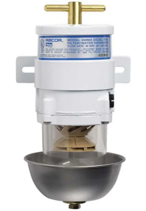
Enough “yuck” and the primary slows fuel delivery to the engine and it slows and eventually stalls.
I am not convinced that fuel polishing/cleaning operations actually get (or can get) to the walls of the tank to scour them and ensure clean fuel. The best we as skippers can do is prepare for the possibility of a clogged primary filter. To this end changing a filter on the fly is good to plan for and practice.
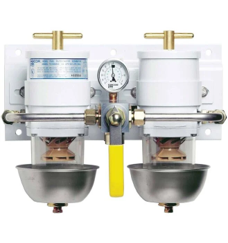
Changing primary filters on the fly is made far easier by the installation of a dual filter assembly such as the dual Racor filter assembly.* This assembly makes the changing of filters a mere flip of a valve. This isolates the clogged filter making it easy and far less messy to change.
In addition, the dual Racor filter assembly has a vacuum gauge which can give early warning of a clogging filter.** Some assemblies also provide an option of early warning of water accumulation in the fuel.
Finally, there is little down-side at carrying a lot of filters. When Alchemy left for extended cruising, we carried 10+ primary filters***
* A dual Racor fuel filter assembly (from memory mine is a 500MA using 2010TM 10 micron filters) and looks just like this:
** A vacuum gauge is also recommended for vessels with a single primary fuel filter just by placing one in the fuel line for its ability to provide early warning. Descriptions of its use and guidance for installation can be found at Steve D’Antonio’s web site (https://stevedmarineconsulting.com/) and search for the articles (among many other useful articles) in his E-Magazine.
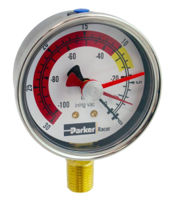
One of the observations made about vacuum gauges is that one can change filters when there is shown to be a rise in pressure indicating that the filter is loading up. I have never done this (or needed to) and tend to change to a new filter once a year which, when cruising full time, often had me using a filter for 250 up to 500 hours. I am not sure whether there is a “recommended” interval as there is for oil filters: hard to do with the quality of fuel potentially varying widely. Because I “polish” my fuel regularly, my filters emerge pretty clean with no build-up of yuck and not even overly darkened element.
*** My Racor primary filter uses 2010TM filters which are easier to store (as much smaller) than spin on filters and are less expensive. They are smaller and take up less space: important as for widely wandering boats who might get bad fuel have lots of spare filters can be crucial. I carried ten when cruising remote areas, in part for the fuel quality when we purchased diesel from 55g steel tanks that were often rusty and old.
The Cruising Club of America is a group of accomplished recreational offshore sailors bound together by friendship and the desire to foster the responsibilities, expertise, and skills needed for the adventurous use of the sea. Safety Articles are updates on marine safety issues, presented by station Safety Officers at meetings. They are published by the CCA Safety and Seamanship Committee and are intended to advance seamanship and safety by highlighting new technologies, suggestions for safe operation and reports of maritime disasters around the world.