Don’t Assume You Can’t Help
Don’t Assume You Can’t Help
“From the CCA School of Hard Rocks
...lessons learned in pursuit of the Art of Seamanship”
By Chuck Hawley, SAF Station, April 2026
For sailboats racing in one of the races from Southern California to Mexico in the 1980s, the coast of Baja California was pretty inhospitable, especially for the racers returning to the U.S. Approximately 700 nm long, the peninsula has very few natural harbors, numerous offshore hazards, virtually no aids to navigation, and only a handful of places to get fuel. The prevailing winds are virtually always from the north, making it fun to race TO Mexico, but far less fun to come home. In many ways, sailors have to be as self-sufficient along that coast as they have to be on a race to Bermuda or Hawaii.
Self-sufficiency includes a number of categories of preparation: a qualified crew, enough provisions, enough fuel for the anticipated time under power, spare parts, “delivery” sails, and even bringing along a dinghy for trips to shore, since marinas were non-existent. Since the non-racing “delivery” gear had to be delivered to a Mexican city by commercial aircraft, the gear list was necessarily modest.
In 1983, I raced to Cabo San Lucas aboard “Charley”, a 67’ sled designed by CCA member Ron Holland, and navigated by CCA member Stan Honey. After a few days relaxing after the race, it was my responsibility to assemble a delivery crew and head back to San Diego. We anticipated a few days of powering, and Charley had a Perkins 85-hp diesel and a modest fuel capacity to keep us moving in the “light stuff”. We had a small assortment of spare parts, but it’s pretty hard to know what might break on a 1,000 pound diesel, and no one on board was a diesel mechanic. We did, at the recommendation of the Perkins distributor, have a spare lift pump, various filters, belts, and maintenance-oriented parts.
Fast forward to the fourth or fifth day on our trip north: as we passed the small island of Isla de San Martin, we received a call on the VHF from another returning boat. The skipper, Bob, turned out to be a friend of mine, and he and his first-mate Carrie were double-handing one of the smallest boats in the race fleet back to Southern California. Their engine had stopped working and they were facing a beat of perhaps 150 miles to San Diego. Could we, they asked, see if we could fix their Bukh (Danish) diesel?
My initial reaction was that it was unlikely that we (actually I) would have the skills or parts to fix an engine that I had never heard of. However, Bob offered to row over in their very modest dinghy, and ferry me over to the 33’ sloop. I grabbed whatever metric tools I could find, as well as the only spare part that we had for our Perkins: the diesel lift pump. When you only have one arrow in your quiver, you go with it.
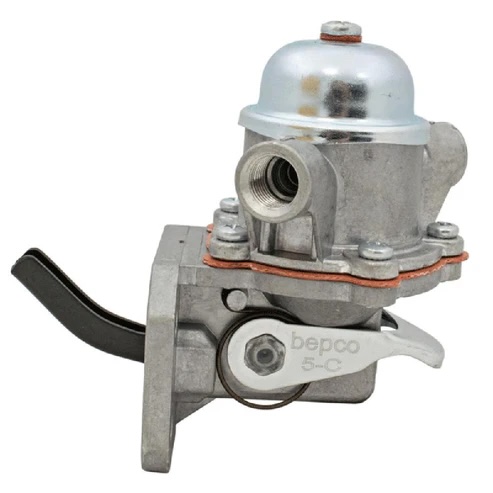
Photo credit: Aftermarket Reliable Parts
To fast forward, it turned out that it was, in fact, the lift pump that was the problem, my English lift pump fit the Danish engine perfectly, and since it was a simple fix I had the proper tools. The engine started immediately after we bled the injectors. Bob and Carrie were very grateful and rowed me back to Charley so both boats could continue their slog upwind.
The lessons learned were many, but here are a few:
- “Giving assistance” comes in many forms. Sometimes it is offering comfort, or advice, or a jug of diesel. Don’t define it too narrowly.
- Have a variety of skills among your crew. The Volvo Ocean Race sailors are excellent racers, but they also have specific skill sets to allow them to fix problems. Look for a diversity of skills among your team.
- Be aware of your surroundings. Look for things that are “out of place.” Monitor the VHF. Scan the horizon with binoculars while on watch. Look for signs of trouble.
- Never Assume You Can't Help. My initial reaction was based on the fact that the engines were different, and I didn't know the Bukh engine. However, the basic principle of how a diesel engine gets fuel is the same across nearly all manufacturers. Had I focused only on the specifics of the Bukh, I would have declined the request. By focussing on the problem—a loss of engine power—it seemed that the most likely common denominator would be the fuel system. Even with limited knowledge or non-matching spare parts, a willingness to look and apply general principles can often lead to a solution. The spare part (the lift pump) was generic enough to fit. Don't let perceived differences or a lack of specific expertise stop you from offering assistance.
The Cruising Club of America is a group of accomplished recreational offshore sailors bound together by friendship and the desire to foster the responsibilities, expertise, and skills needed for the adventurous use of the sea. “School of Hard Rocks” stories are first-hand accounts of something that went wrong on a voyage, and what can be learned from the experience. They are published by the CCA Safety and Seamanship Committee, are intended to advance seamanship and help skippers promote a Culture of Safety aboard their vessels.